#EYALearning: How Gwent Archives are Supporting Teachers and Students
Archive services across Wales are a great opportunity to support both teachers and students, of all age ranges, and solidify the value of archive collections in education. For #EYALearning, I wanted to highlight one way the team at Gwent Archives are approaching this opportunity.
In September 2026, an updated GCSE History was launched as part of the new curriculum in Wales. This new GCSE explores Welsh history – globally, nationally and locally – with Unit 1 focusing on ‘An in-depth study on Welsh history’.
Unit 1 explores six historical topics across three time periods – medieval, early modern and modern. Students have to complete a written exam on one of these topics, which is worth 30% of their qualification. The 6 topics are as followed:
Medieval:
1.1 Owain Glyndŵr c.1354–1416
1.2 Rhys ap Gruffudd, Prince of Deheubarth c. 11-32-1197
Early Modern
1.3 Wales and the early Tudors, c.1485–c.1547
1.4 Wales in the era of the Civil War, 1603–1660
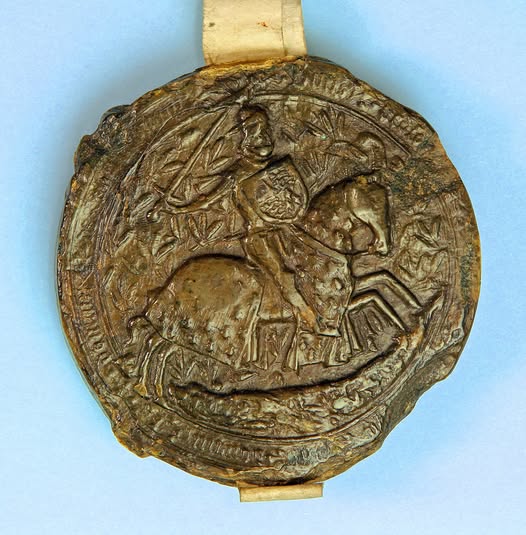
1492. Gwent Archives
Modern:
1.5 Rebellions and Protest in Wales c.1831–c.1891
1.6 Wales in the early to mid-twentieth century c.1914–c.1959
So, how can archive services support teachers and students in this new GCSE?
At Gwent Archives, we are creating a new educational guide for the new GCSE History. This guide will provide a suggested list of items from our collections including our local studies library for each of the 6 topics. This guide will be available on our website and distributed to teachers across the five councils our archive service covers – Torfaen, Newport, Monmouthshire, Blaenau Gwent and Caerphilly. The guide can be used both by teachers who want to visit the archive service to conduct research, plan activities and inform their teaching of the module as well as by the archive service as a list of items to put together for GCSE History groups visiting the archive or visits to schools.
In preparation for this guide, we ran two workshops at Gwent Archives with the team to brainstorm which items could be relevant for each topic. In these workshops, we closely reviewed the 5 areas within each topic and created a list of suggested items in our collection to signpost teachers to (see pages 14 to 25 of the WJEC Specification for the new GCSE History which can be found here).
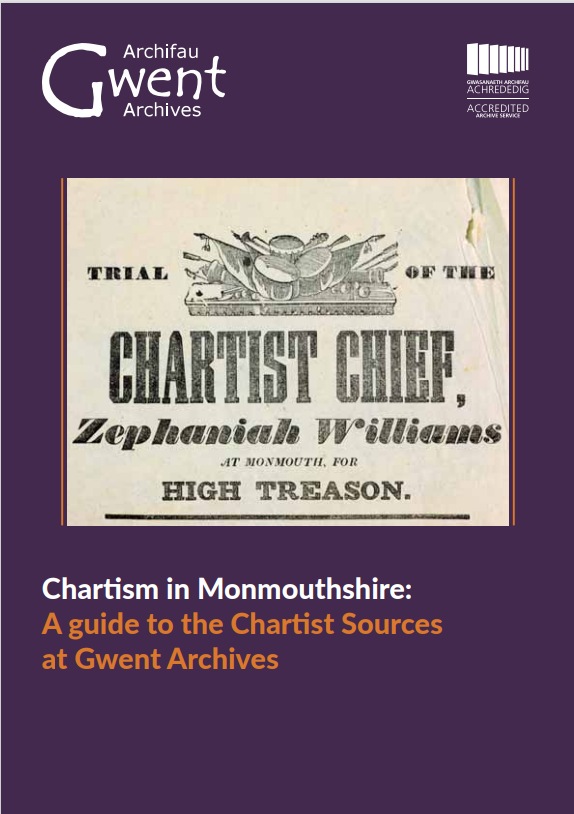
We made sure to identify existing guides on our collections and where they could be signposted to. For example, within 1.5 Rebellions and Protest in Wales c. 1831-1891 area 1.5.3 is Chartism in Wales. With our archive service covering Newport and South East Wales, we have many items on Chartism and already have a comprehensive guide on Chartism across our collections on our website which we can signpost to in the GCSE guide (see here: https://gwentarchives.gov.uk/media/3z4j21vz/chartistguide.pdf)
As well as identifying items in our own collection, we are including in the guide online resources that teachers can access for free such as Wales Newspapers Online, Tithe Maps, Wales Journals Online, Clip Corner, OS Maps and more.
During this process, we have come across challenges in putting this guide together. Some areas within the 6 topics are beyond the geographical focus of our collections. For instance, whilst we have many items on Chartism in 1.5 Rebellions and Protest in Wales c. 1831-1891, the Merthyr Rising 1831, Rebecca Riots 1839-1843 and The Tithe War in Northeast Wales, 1886–1891 are all beyond our geographical focus and areas we could provide little support with beyond some contextual historical books in our local studies library. In addition, our collections start from the 13th century and so likewise for 1.1 Rhys ap Gruffuss, Prince of Deheubarth c. 11-32-1197, we’re unable to provide items from our collection on this topic specifically.
To mitigate this, we are including in the introduction of the guide a list of highlighted areas and topics which are especially relevant to our geographical area. This will highlight for instance: Chartism; items from the Tudor period and Civil War; World War One in South East Wales; the industries of coal, iron and steel; Aneurin Bevan, the NHS and health records; women across our collections; the experience of immigrants to Wales particularly in the multi-racial diverse community of Newport and the impact of the docks; how castles can shed light on the Medieval period; and more. This will further support teachers in which of the 6 topics to select.
This is a renewed opportunity for archive services across Wales to highlight how valuable our collections can be in supporting teachers, students and education in Wales. Will you make your own guide?