Further Secrets of the Welsh Women’s Peace Petition
In my last blog I suggested that further research might shed some more light on the signatories of the 1923 Peace Petition that lived at the ‘strange addresses’ in the Ely area of Cardiff. That looked unlikely when I came to look at the sources available: the details of the 1931 Census are unavailable as the whole thing was destroyed in a fire and there was no census in 1941 due to World War Two; the next available Census would be 1951 – nearly thirty years later than the Peace Petition- and that wouldn’t be available until 2052 !
However in September 1939, with the onset of the Second World War, there had been a National Register compiled to facilitate the issuing of identity cards. Having issued forms to more than 41 million people, the enumerators were charged with the task of visiting every household in Great Britain and Northern Ireland to collect the names, addresses, marital statuses and other key details of every civilian in the country, issuing identity cards on the spot. It was 16 years after the petition and many of the women may be under different names by then through marriage or divorce, but at least it was something!
Using the data of the Peace Petition, the 1939 Register, The Western Mail and parliamentary records it has been possible to piece together some of the stories of those women of Ely in 1923.
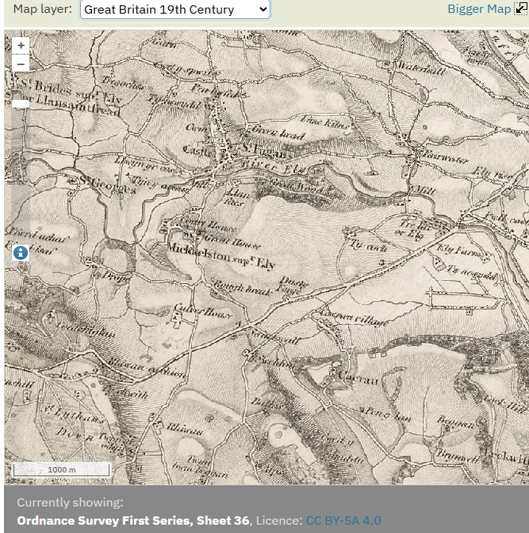
The Ely Housing Scheme
The immediate context of the municipal housing scheme at Ely was the passing of the Addison Housing Act in 1919. This aimed to fulfil Prime Minister Lloyd George’s promise of ‘houses fit for heroes’ and, in the specific context of Cardiff, to meet the housing crisis in the city, both in terms of a shortage of dwellings and in the quality of housing as there were, according to Edgar L Chappell in 1920, ‘a considerable number of dilapidated and unfit houses’. Moreover the Act also guaranteed a state subsidy for local authorities, who were given a duty to survey housing needs and to come up with and carry out appropriate plans.
The scheme in Ely was not straightforward – it involved the purchase of two farms in Ely, between Cowbridge Road and the River Ely, bounded by Mill Road, Red House Farm and Green Farm, as well as an Act of Parliament to redraw the boundaries of the city of Cardiff to include the area within them. Moreover, because the state was subsidising the scheme, it needed their approval, which was not forthcoming for their first proposals, leading to the MP for the area, James Gould to ask the minister responsible, Sir Alfred Mond, in a parliamentary question on April 11th 1921:
Whether he has received from the Cardiff City Council, either directly or through the housing commissioner, a protest against his action in refusing to approve housing contracts on the Ely site at prices mutually agreed on by the city engineer, the local master builders’ association, and the representative of the housing commissioner; and whether, in view of the refusal of the City Council to reduce housing standards still further in order to secure lower prices, he will state what steps he proposes to take in order to meet the serious shortage of houses in the city?
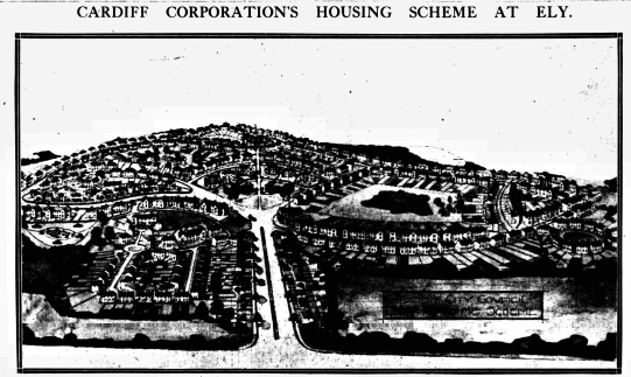
Even when approval was provided there were problems: on 6th May 1921 The Western Mail reported on Housing Impasse as the housing committee of Cardiff Council voted against the request of the builders, Waller Housing Corporation, for extra funds to complete the first 250 houses. The contract was withdrawn and the whole tender process began again. Nevertheless, The Western Mail was eventually able to publish (on 28th June 1922) and artists’ impression of what the Ely Housing Scheme would look like when completed:
The Peace Petition Women
In total, I was able to identify 99 signatories of the Peace Petition who had ‘strange addresses’ in Ely. These included 21 names on Road 9, 25 on Road 12 and 53 on Road 2. Most of them only had initials, such as M Jones of 48R Road 2, so there would be no hope of tracing them. However in some cases where there were full names I was able to trace them with some confidence in the 1939 register and, in fewer cases, back to the 1921 Census.
Rachel Judd, for example was living at 61 E1 2 Road Ely when she signed the Peace Petition. There was a Rachel Judd living at 41 Phyllis Crescent at the time of the 1939 Register, who had been born in 1896 and was married to Ernest Judd, born in 1881 (further links showed that they had been married in 1920 and had a daughter, Valerie, born in 1924) – so this was a pretty solid connection.
Frances Mary Cowling was living at E60 No 2 Road Ely when she signed the Peace Petition. There was a Frances M Davies (Cowling) – luckily she recorded her maiden name! – living at 25 Phyllis Crescent in the 1939 Register (born 1888).
Agnes Jasper was living at 49 Left 2 Road when she signed the Peace Petition; an Agnes Jasper (born 1896) was living at 28 Phyllis Crescent in 1939. In this case, it also looks like we have a link to the 1921 Census as well, as there was an Aggie Jasper, married to George Jasper, living at 45 Metal Street in the Splott area of Cardiff, which had grown up as housing for the metal trades (other roads in the area are Iron Street, Copper Street etc). So it looks like this might be a case a relocation from poor standard housing to the much better standard of the Ely Estate. They also had a daughter born in 1924. Interestingly, George is recorded as a Horse Driver in the 1921 Census and by 1939 he is a Motor Lorry Driver – certainly moving with the times!
Finally Lydia Holland was living at B58 Road 12 Ely when she signed the Peace Petition and by 1939 was at 36 Pencader Road.
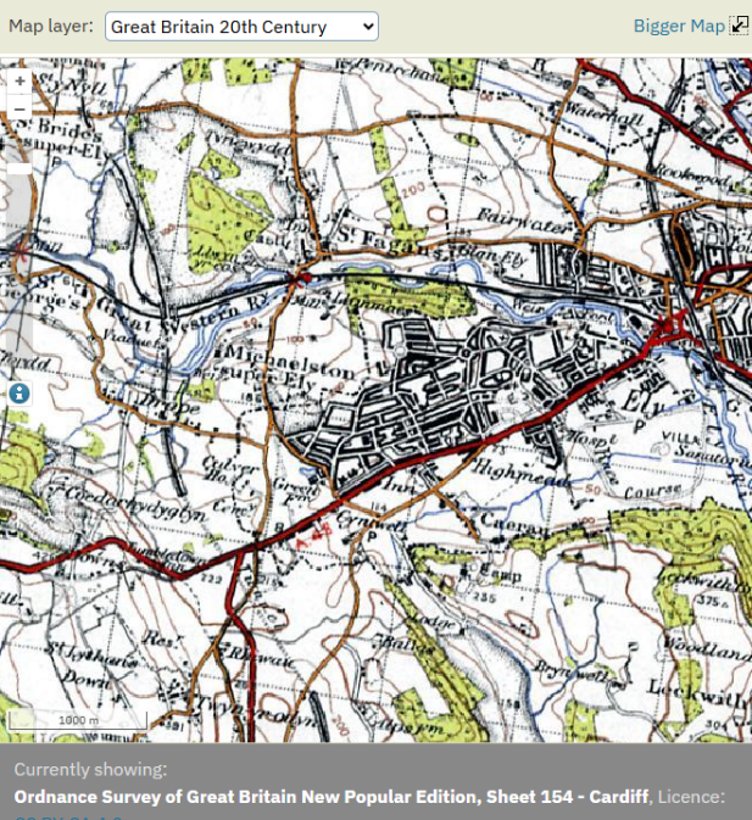
Four out of 99 isn’t that many, but for three people to be living in one road in 1923 (Road 2) and for those three women to be living in another road (Phyllis Crescent) in 1939 presents a strong suggestion that they stayed put and that Road 2 and Phyllis Crescent are the same place. This is perhaps reinforced by the detail that Phyllis Crecent is the key road linking Grand Avenue and Mill Road and thus may have be one of the first roads built.
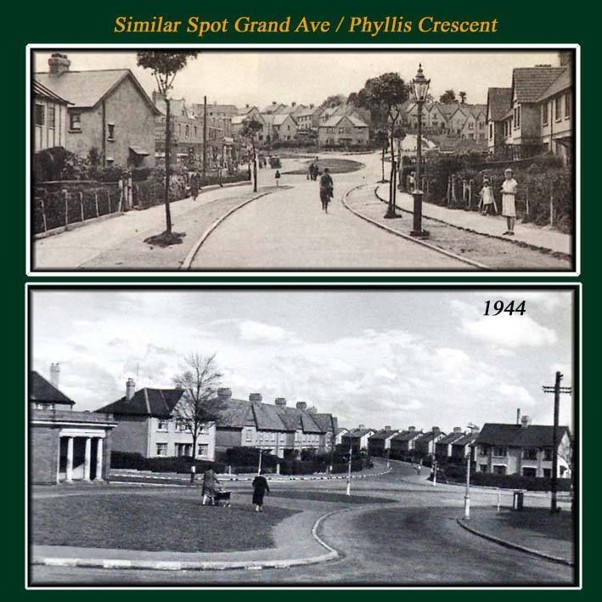
The photographs below show the junction of Grand Avenue and Phyllis Street (which was renamed Heol Muston in 1963) in 1944 and at an unnamed, but earlier date. I’m suggesting that that this might have been in the 1920s, shortly after the building was completed. Grand Avenue first appears in The Western Mail in October 1923, so it looks like it was named by then – but no signatories in the Peace Petition have that address.
As the development grew, the origins of the estate became even more apparent as roads named Red House Crescent, Red House Close and Ty-coch Road appeared, followed by Green Farm Close, Greenfarm Road and, eventually Green Farm Park, all named after the two original farms.
The Welsh Women’s Peace Petition may well hold other secrets within its hundreds of thousands of signatures, but this shows it to be a unique snapshot of a dynamic society in Wales in the 1920s, capturing something that, without it, would certainly be lost but, with other sources in the National Library of Wales, can release its secrets.